
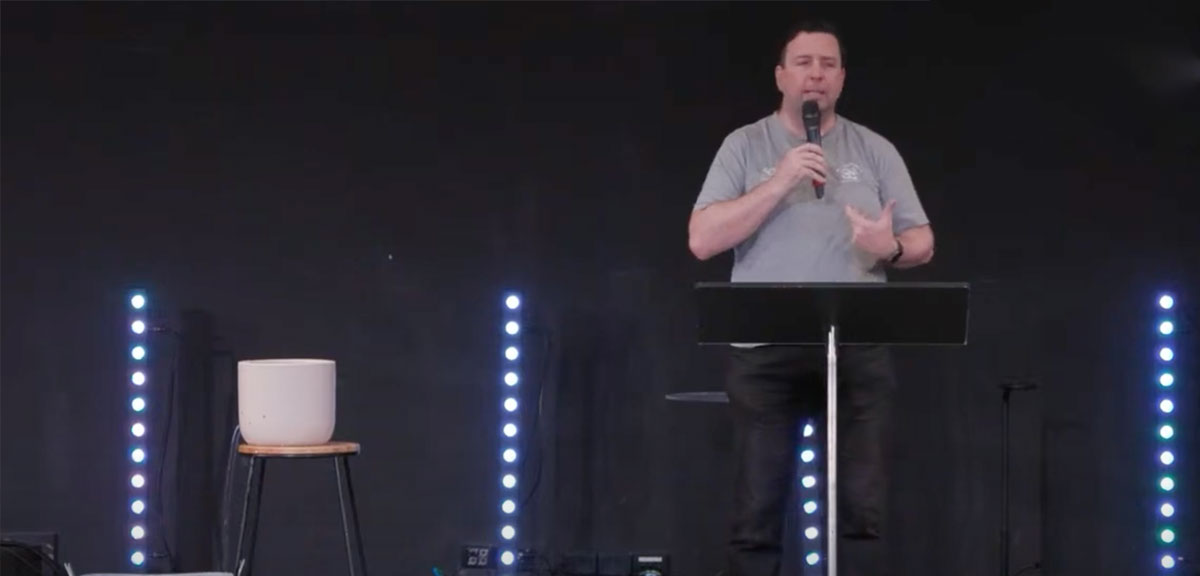
I recently had the opportunity to speak at Croydon Hills Baptist Church on the topic of “My Favourite Verse”.
The video linked above is of the whole service, but it should be time tracked to when I get up to speak.
A rough transcript of the talk for those who would prefer to read is below.
When I was asked to speak about my favourite verse, I knew instantly which verse I would choose. This is a verse that I discovered as a teenager, and it was one of those verses that just jumped off the page for me.
There are two things about this verse that I liked particularly. The first is that it was not one of the cliché favourite verses. It was not a John 3:16 or a Jeremiah 29:11. It was not one that people would know, which meant that they would have to go and look it up themselves. And back then, that wasn’t a search on the internet, it was actually getting a Bible and looking it up.
This isn’t a verse that you’ll see on a bumper sticker. You probably won’t find it on a bookmark or a magnet at Koorong. Your favourite Christian influencer probably won’t be posting it on their instagram reels.
The second thing about this verse, which was really what made it my favourite though. Is that I reckon if you were to go to God and ask for his take on theology, this would be the one verse that he would go to over any other. That’s a pretty big statement, but I think I’ve got some good evidence for that bold claim.
The verse?
Jeremiah 2:13
It says this: “My people have committed two sins: They have forsaken me, the spring of living water, and have dug their own cisterns, broken cisterns that cannot hold water.”
Now, there’s probably one word in that verse that in our modern day reality, deserves some explanation. I’m pretty sure that most of you, if not all of you, like me, have ready access to water at the turning of a tap.
That, of course, is not the case everywhere in the world. But regardless, in the scope of human history, it is still a relatively recent technological advancement.
So to explain the concept of a cistern, I would like to lean on the great Australian theological work: The Castle. If you know it, and maybe even if you don’t, you might recognise this line.
“Dad, I dug another hole… It’s filling with water”
You see, when these words were written (not The Castle quote, the Bible verse) there were three main ways to get water. You could walk to the river, you could go to a spring or well to access the underground water. Depending on where you lived, both of these options could involve quite a long walk. Or you could have some kind of local container in which you could store that water, so you didn’t need to collect it every day.
A cistern was essentially a water tank made of stone and clay, which could collect and store water. Quite literally, a hole in the ground.
Now, it was going to be a bit difficult to dig a hole up here, so I had to improvise. But I just felt a visual would help us get the idea. And I’m going to need a couple of volunteers.
Okay, so why, as a teenager, did this verse jump off the page to me?
I was a volunteer Leader on a camp when I met Luke. As a good Leader I was sharing about Jesus and getting nowhere. Luke says to me, “My father is in prison, I only get supervised visits with my mum. And after the holidays I’m starting at my new school, because I’ve been kicked out of my last two. This Jesus stuff is okay for people like you, but you don’t know the things I’ve done.”
Time and time again I would talk to young people and hear a similar story. The tally of their sins was just too high.
Here’s my commentary on Jeremiah 2:13 - God can count all the stars in the sky, all the grains of sand on the shores of the sea, all the hairs on your head, but when it comes to sin he only counts to two.
Naomi was a girl who came to youth group, invited by a friend. But she had not grown up with any sense of Christian morals or values. And if you could think back to the 80’s and 90’s and what the boxes would be to tick for a “good Christian girl” - Well, she pretty much ticked all the opposite boxes.
She felt that she pretty much sinned more in a week than some of the other kids in youth group had in their entire life. But while she saw her sins in the thousands, God stopped counting at two.
And understanding this is something that changed the way I was able to communicate the Gospel. It levelled the playing field. Because these were the only two sins that mattered. And I could say, “We’re not that different, you know”.
Ih John 4 we read about a woman, whom the text makes clear could fit into this box of feeling her sins were too many. I wonder, had Jesus been meditating on Jeremiah 2:13 that day?
“If you knew the gift of God and who it is that asks you for a drink, you would have asked him and he would have given you living water.”
Now it would be easy to stop there, an encouragement that no matter how great or many the sins in our life, that doesn’t stop us coming to God. It doesn’t stop us accessing that living water.
But the truth is, this verse was not written to people who thought they’d sinned too much. It was written to a people who thought they hadn’t sinned at all. Or perhaps those who knew their sins were forgiven. Perhaps like you and me.
Jeremiah 2:13 doesn’t say “some people”, it doesn’t say, “those people, those over there”. It says, “my people”. And if you are a follower of Jesus, then you fit into that title.
And here, I believe, is the cry of God’s heart in Jeremiah 2:13 to all of us - Stop digging cisterns and come back to the spring.
God never says that cisterns are bad, he just says that they are broken.
All over the world, there are people filling church pews, but digging cisterns.
Let me be controversial for a moment.
I go to church every Sunday. Cistern. I read my Bible. Cistern. I’m in a small group. Cistern. I lead on a camp. Cistern. I went on a missions trip. Cistern. I tithe. Cistern. I listen to the Christian radio station. Cistern. I speak on a stage in a church. Cistern.
We’ve spent so much time, and by we I mean evangelical Christianity, focusing on what Jesus saves people from, that we can sometimes forget what he saved us for.
Jesus goes on to say to the woman at the well, “Indeed, the water I give them will become in them a spring of water welling up to eternal life.”
You see, the best we can hope for with a cistern is that it doesn’t leak too much, that the water doesn’t run out, that we have enough to survive.
But living water doesn’t leak, it overflows.
That’s when you go to church on a Sunday, because it empowers you for Monday. When you read your Bible, because it opens your eyes and fills your soul. When you lead on a camp, or go on a missions trip, it’s because you need to share this life inside you, because it’s too wonderful to keep to yourself. When you tithe and give, it’s because you see a small part that you can play in a much bigger plan.
It is because living water is flowing through you and can’t be contained.
We get so, so caught up in trying to dig better cisterns, when all we’ve ever needed to do was go back to the spring.
In Revelation 22, the very last chapter of the Bible, we read about not a spring, but a river. This is not a trickle, this is not a drip, this is not something that can be contained. Overflowing, abundant, eternal life.
Because here’s the thing, when Jesus talked about living water, it was never about the water, it was about the living.

Lloyd McLean
Lloyd McLean is from Melbourne, Australia and enjoys writing, speaking and going on adventures!
You Might Also Like

My Favourite Verse
January 2025